Today, Artificial Intelligence (AI) is the absolute priority in the boardrooms of financial institutions. The paradox, however, is that while the board demands predictive decision-making and hyper-personalization, the critical infrastructure (the mainframe) often remains isolated by data silos and development processes that do not keep pace with digital speed.
This fragmentation is not just a technical bottleneck—it is a leakage of profit. When essential data from the transactional core is disconnected from the digital edge, strategic vision becomes short-sighted.
According to SNS Insider, the mainframe modernization market is expected to reach $12.77 billion by 2032, reflecting the urgency of transforming legacy systems into engines of agility.
Artificial intelligence is only as strong as the latency of the data that feeds it; without integrating the transactional core, AI becomes nothing more than an expensive ornament built on an inefficient foundation.
The anatomy of friction: latency, inconsistency, and systemic risk
In the financial sector, real-time data consistency is the boundary between competitive advantage and operational disaster. Latency erodes customer trust and, at extreme levels, leads to direct financial losses.
The market still carries scars from failures that did not originate in the technology itself, but in its validation. In 2018, TSB Bank successfully migrated its core—on paper. In practice, it went live without sufficient testing, causing widespread service outages, data exposure, and more than £330 million in financial impact.
This serves as a severe warning about the risks of maintaining unsynchronized environments and outdated validation processes.
The old “dumb terminal” mindset has been replaced by what now manifests as a structural asymmetry in processing consumption. The expansion of mobile banking and real-time payments has exponentially increased the volume of interactions with the core (queries, validations, synchronizations, and API calls) without generating proportional revenue growth.
In practice, the mainframe is now sustaining a growing load of high-frequency, low-value operations, putting pressure on MIPS consumption and operational costs. This imbalance between volume and monetization is no longer a technical detail—it is a direct financial efficiency issue.
This scenario requires the mainframe to process massive volumes without synchronization errors between back-end and front-end. Modernization, therefore, is not a technical aspiration, but a governance requirement to ensure business continuity.
Interoperability as invisible infrastructure: the role of Smart Data Fabric
Interoperability should not be treated as an isolated IT project, but as the strategic foundation that enables continuous innovation without the need for disruptive rip-and-replace migrations.
The concept of Smart Data Fabric, enabled by solutions such as InterSystems IRIS, acts as the orchestration layer that makes data “invisible” and omnipresent.
This architecture eliminates friction between legacy systems and modern applications, transforming raw data into assets ready for AI.
By ensuring that digital-edge decisions are based on the transactional truth of the back-end, financial institutions gain the agility of the cloud while maintaining the security of the mainframe. However, data fluidity only creates value if changes in the core are executed flawlessly. This is where data orchestration meets execution security.
Mainframe as a strategic asset: Eccox and the transformation of the transactional core
The mainframe is a living platform for innovation. Eccox, a Brazilian company with 34 years of leadership and a partner in the IBM Partner Plus Program, understands that modernization is the growth pillar for the country’s largest banks, including Bradesco, Itaú, Santander, Caixa, and Banco do Brasil.
Through its Innovation Lab, Eccox developed Eccox APT (Application Environment Management for Parallel Testing), a disruptive solution that introduces containerization for z/OS.
Eccox APT enables test isolation and parallelism, eliminating the historical bottlenecks of mainframe development. Its key differentiator is the execution of real tests—without emulation or mocks—ensuring full fidelity to production behavior. The impact on business metrics is direct:
Up to 80% reduction in testing time: by eliminating data conflicts and enabling multiple teams to work simultaneously
25% to 40% acceleration in Time-to-Market: ensuring new products reach the market ahead of competitors
ROI in 6 to 8 months: transforming the mainframe from a cost center into an innovation accelerator
By offering self-service environments through a user-friendly web interface, Eccox APT enables the onboarding of low-platform talent, making the ecosystem more attractive and accessible to developers without prior mainframe experience.
Eccox + InterSystems convergence: the Intelligent Core in action
The synergy between InterSystems (data orchestration) and Eccox (consistency and scalability assurance) creates what we define as the Intelligent Core.
While InterSystems delivers data agility, Eccox acts as a high-performance safety brake, ensuring that speed does not translate into systemic errors.
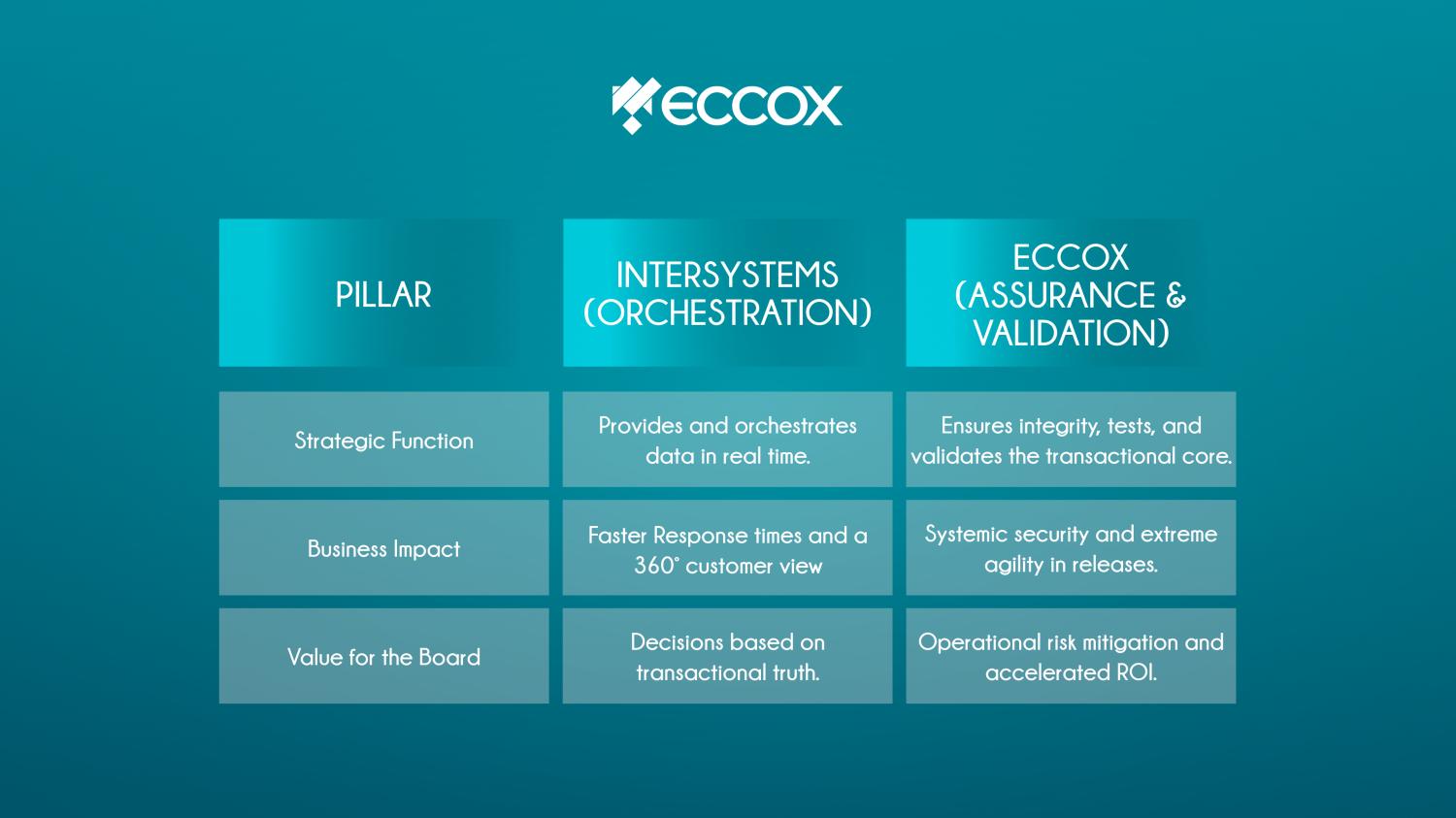
This combination allows Heads of Data and Architecture to deliver what the board demands: AI powered by real data, without the risk of catastrophic production failures.
Mainframe modernization is an evolutionary journey, not a migratory one. Treating the transactional core as a strategic asset is the only way to sustain competitive advantage in the AI era.
Adopting an Intelligent Core ensures short-term agility gains and long-term systemic stability.
As a milestone in this evolution, Eccox is launching AI-driven capabilities integrated into APT in the first half of the year, definitively connecting board-level intelligence demands to technical execution in the mainframe.
Eccox is the strategic partner that orchestrates value in the most critical layer of the financial sector—ensuring that the transactional engine also becomes the engine of corporate intelligence.
If AI has already entered the strategic agenda, the next step is not to invest more, but to connect better!


About Post Author